
Sittercity
Sittercity
Families who invite sitters to apply are
2x more likely to convert to premium. I redesigned the onboarding experience to drive more of them there.
Families who invite sitters to apply are
2x more likely to convert to premium. I redesigned the onboarding experience to drive more of them there.
What is Sittercity?
What is Sittercity?
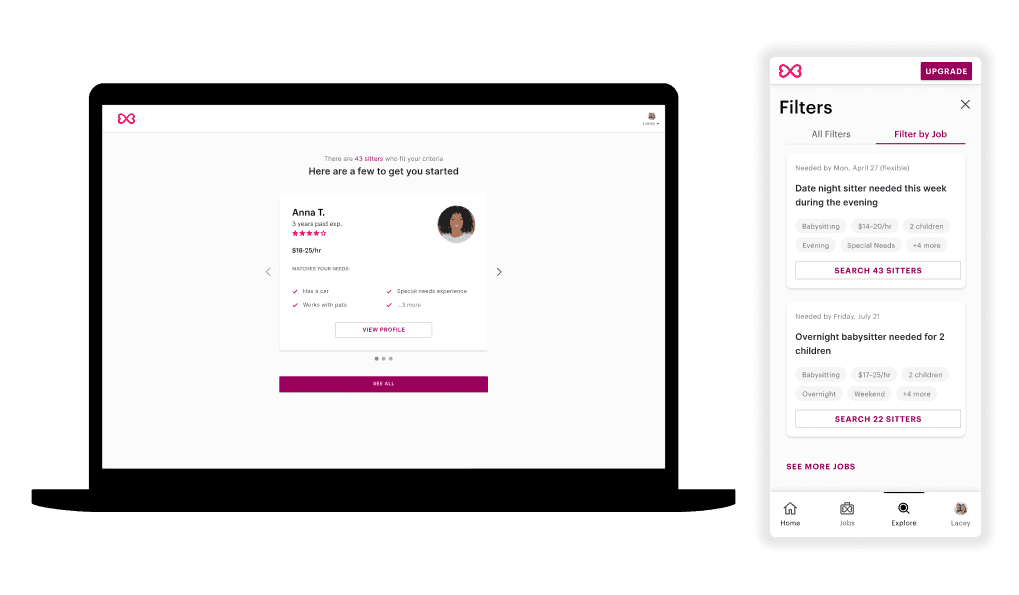
Sittercity is an online marketplace connecting families with local childcare providers. Families post jobs, browse sitters, and book care - all in one place
Sittercity is an online marketplace connecting families with local childcare providers. Families post jobs, browse sitters, and book care - all in one place
My role
My role
Senior Product Designer. Two person design team. I owned the sitter and match side of the product. This project touched both sides.
Senior Product Designer. Two person design team. I owned the sitter and match side of the product. This project touched both sides.
The challenge
The challenge
Match rates were falling. Digging into the data revealed a deeper issue, families were posting jobs and disappearing. Conversion to premium was low, and the platform's most valuable action was nearly invisible to the people who needed it most.
Match rates were falling. Digging into the data revealed a deeper issue, families were posting jobs and disappearing. Conversion to premium was low, and the platform's most valuable action was nearly invisible to the people who needed it most.
STEP 1 OF 4
Discovery
Discovery
Data & Analytics
Data & Analytics
Working with our PM we uncovered a key insight -> families who invite sitters to apply are 2x more likely to convert to premium.
(this is one of Sittercity’s main revenue streams)
Working with our PM we uncovered a key insight -> families who invite sitters to apply are 2x more likely to convert to premium.
(this is one of Sittercity’s main revenue streams)
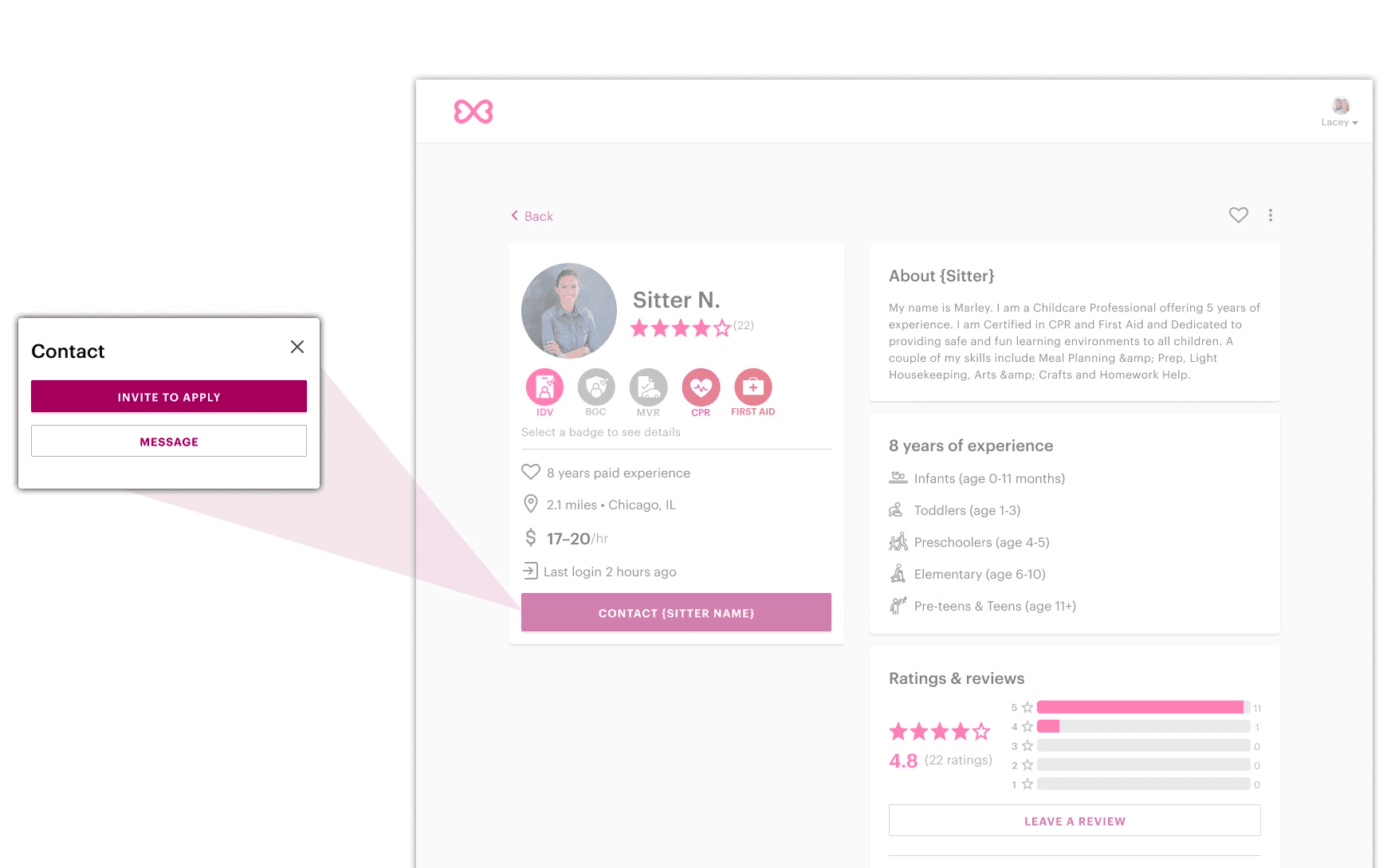
Sitter Profile
Sitter Profile
Competitive Audit
Competitive Audit
Competitors weren't dropping families off after job posting.
They were guiding them, educating users on next steps and landing them on a filtered sitter search page.
We weren't doing either.
Competitors weren't dropping families off after job posting.
They were guiding them, educating users on next steps and landing them on a filtered sitter search page.
We weren't doing either.
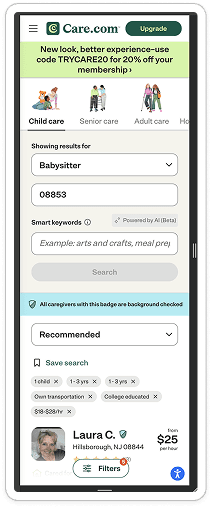
Care.com | Filtered Sitter list
Care.com | Filtered Sitter list
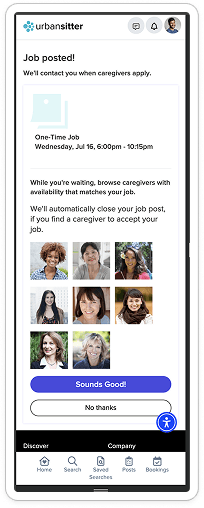
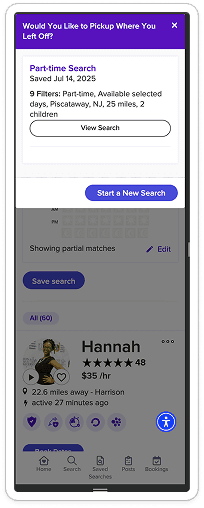
Urban Sitter | Next Step + Filtered Sitter List
Urban Sitter | Next Step + Filtered Sitter List
User Signal
User Signal
Speaking with internal users, one person flagged they didn't even know inviting a sitter was an option.
It wasn't a motivation problem. It was a visibility problem.
Speaking with internal users, one person flagged they didn't even know inviting a sitter was an option.
It wasn't a motivation problem. It was a visibility problem.
STEP 2 OF 4
Solution
Solution
Based on what we learned in discovery the goal was clear; create a guided path that educated families, surfaced the invite feature, and gave them productive next steps immediately after posting.
Welcome + How It Works
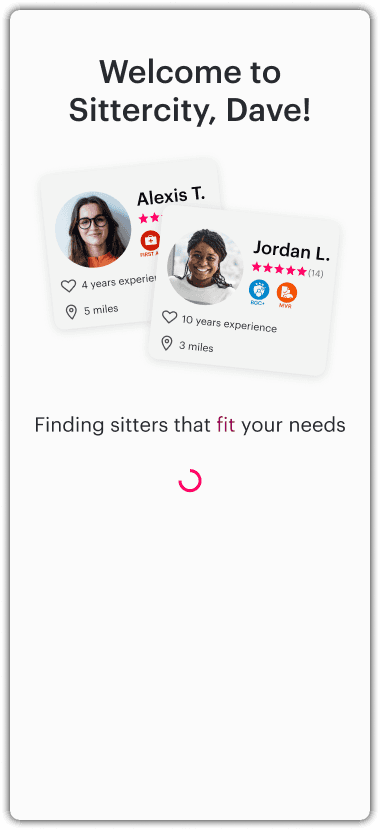
The most important screen in the flow. I used this section to explicitly teach families about the invite feature, surfacing it as a recommended action rather than hiding it in the UI. If they knew it existed they'd use it.
Filtered Sitter Match
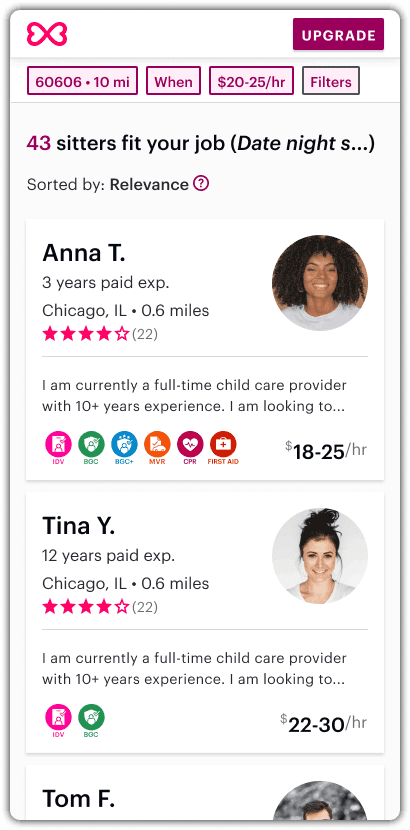
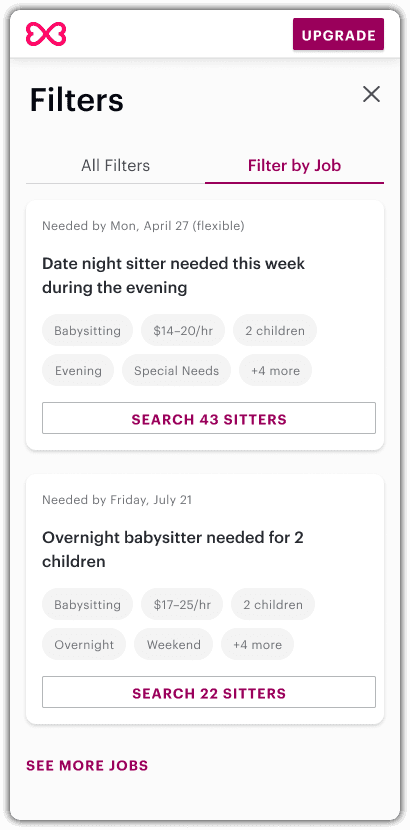
Instead of landing families on a generic browse page I dropped them directly onto a sitter search page pre-filtered by their job requirements. Less friction, more relevance, faster path to action.
Get Started Checklist
This was a net new addition. Before this families had no anchor after posting, engagement would drop because there was nothing telling them what to do next. The checklist gave them clear productive steps including inviting a sitter as a priority action.
Based on what we learned in discovery the goal was clear; create a guided path that educated families, surfaced the invite feature, and gave them productive next steps immediately after posting.
Welcome + How It Works
The most important screen in the flow. I used this section to explicitly teach families about the invite feature, surfacing it as a recommended action rather than hiding it in the UI. If they knew it existed they'd use it.
Filtered Sitter Match
Instead of landing families on a generic browse page I dropped them directly onto a sitter search page pre-filtered by their job requirements. Less friction, more relevance, faster path to action.
Get Started Checklist
This was a net new addition. Before this families had no anchor after posting, engagement would drop because there was nothing telling them what to do next. The checklist gave them clear productive steps including inviting a sitter as a priority action.
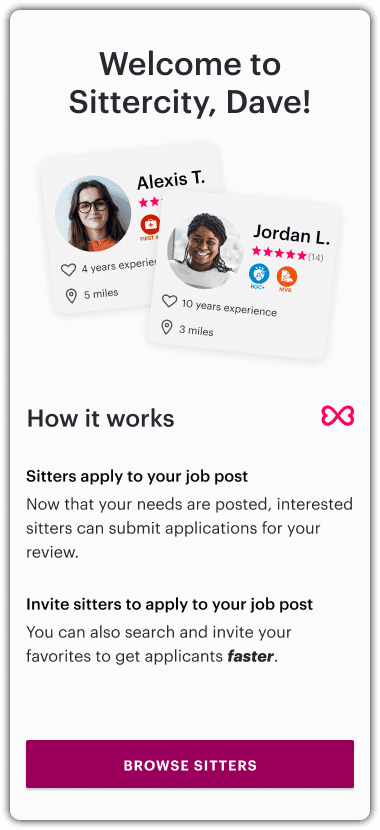
Welcome + How It Works
Welcome + How It Works
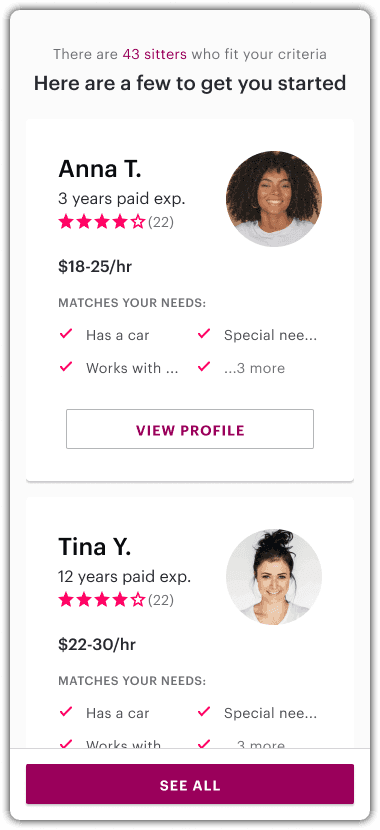
Filtered Sitter Match
Filtered Sitter Match
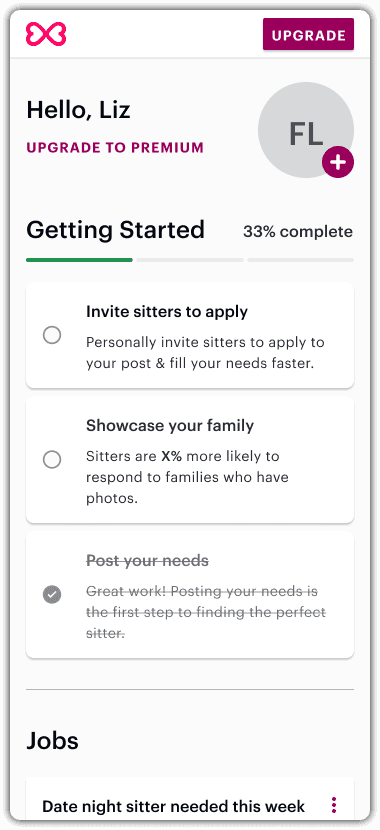
Get Started Checklist
Get Started Checklist
STEP 3 OF 4
Testing
Testing
A/B Test - Surfacing the Invite Feature
A/B Test - Surfacing the Invite Feature
After hearing from an internal user at our parent company that they didn't know inviting a sitter was an option I ran an A/B test to validate the hypothesis at scale.
The Test
Control -> "invite to apply" button hidden behind "contact" on sitter profiles (existing behavior)
Variant A -> "invite to apply" button surfaced prominently on sitter profiles
After hearing from an internal user at our parent company that they didn't know inviting a sitter was an option I ran an A/B test to validate the hypothesis at scale.
The Test
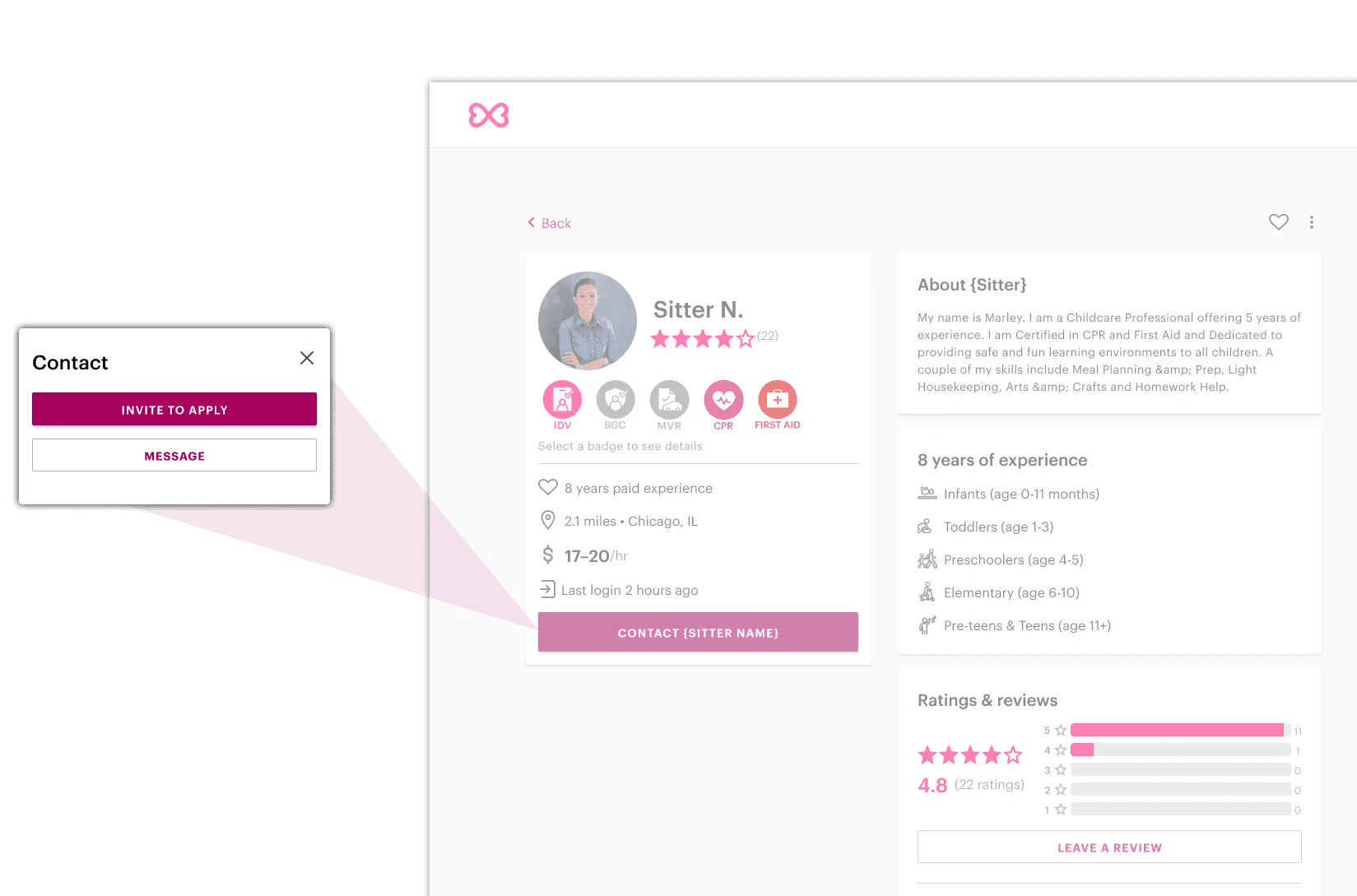
Control -> "invite to apply" button hidden behind "contact" on sitter profiles (existing behavior)
Variant A -> "invite to apply" button surfaced prominently on sitter profiles
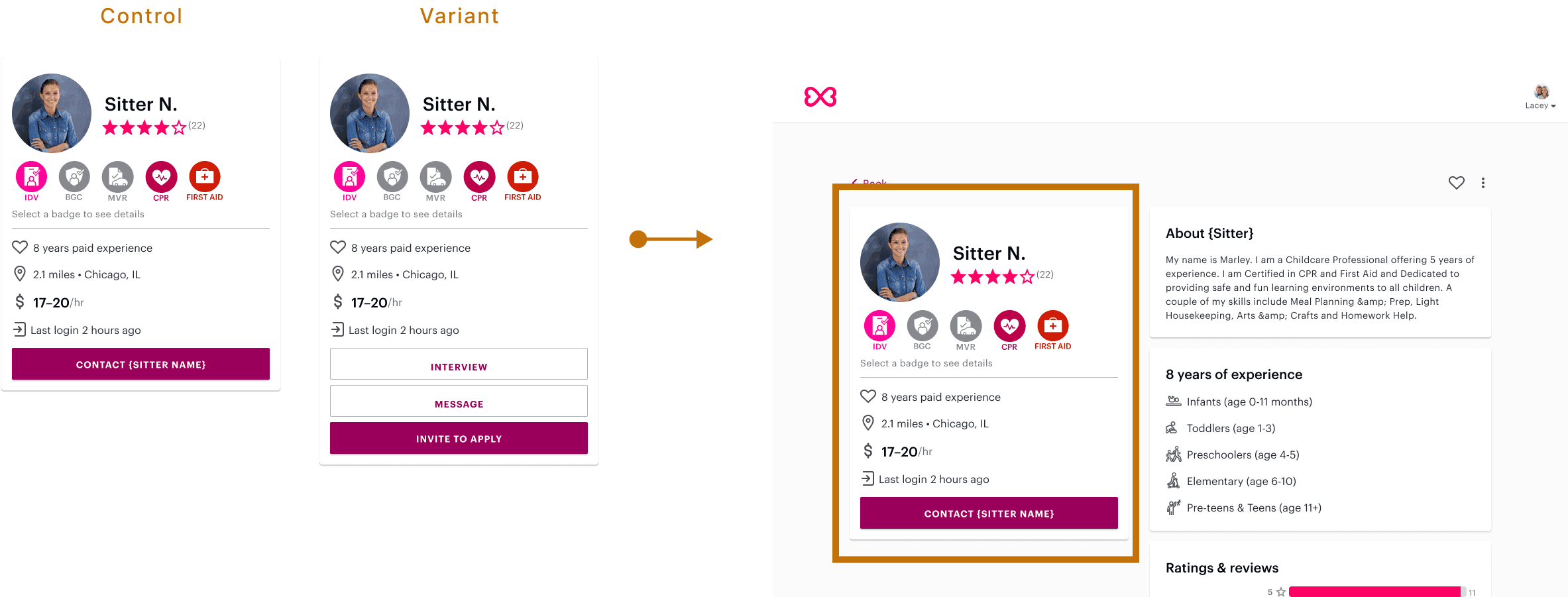
A/B Test Screens
The Results
The variant won at statistical significance.
Families who saw the invite button used it more and conversion followed. The test was still running at the time I left but the data was pointing clearly in one direction.
The Results
The variant won at statistical significance.
Families who saw the invite button used it more and conversion followed. The test was still running at the time I left but the data was pointing clearly in one direction.
STEP 4 OF 4
Outcome + Reflection
Outcome + Reflection
What Changed
What Changed
Families went from posting jobs and disappearing to having a clear path forward.
The invite feature, previously buried, became a visible and used part of the experience. The A/B test confirmed that visibility alone was enough to change behavior.
Families went from posting jobs and disappearing to having a clear path forward.
The invite feature, previously buried, became a visible and used part of the experience. The A/B test confirmed that visibility alone was enough to change behavior.
What I Learned
What I Learned
The biggest UX problem here wasn't the interface. Families weren't failing to convert because the product was hard to use. They were failing because no one had shown them the most important thing they could do.
Sometimes the most impactful design decision isn't a new feature, it's making an existing one impossible to miss.
The biggest UX problem here wasn't the interface. Families weren't failing to convert because the product was hard to use. They were failing because no one had shown them the most important thing they could do.
Sometimes the most impactful design decision isn't a new feature, it's making an existing one impossible to miss.
Click to copy:
Click to copy:
myricklawson.a@gmail.com
myricklawson.a@gmail.com
LET'S WORK
LET'S WORK
Connect with me
Connect with me