Bringing a founder’s vision to life, solo.
As Astray’s sole product designer, I shaped a buildable pet recovery MVP with found-pet reporting before signup, clear emergency interactions, and neighborhood connections that give people a reason to participate before a pet goes missing.
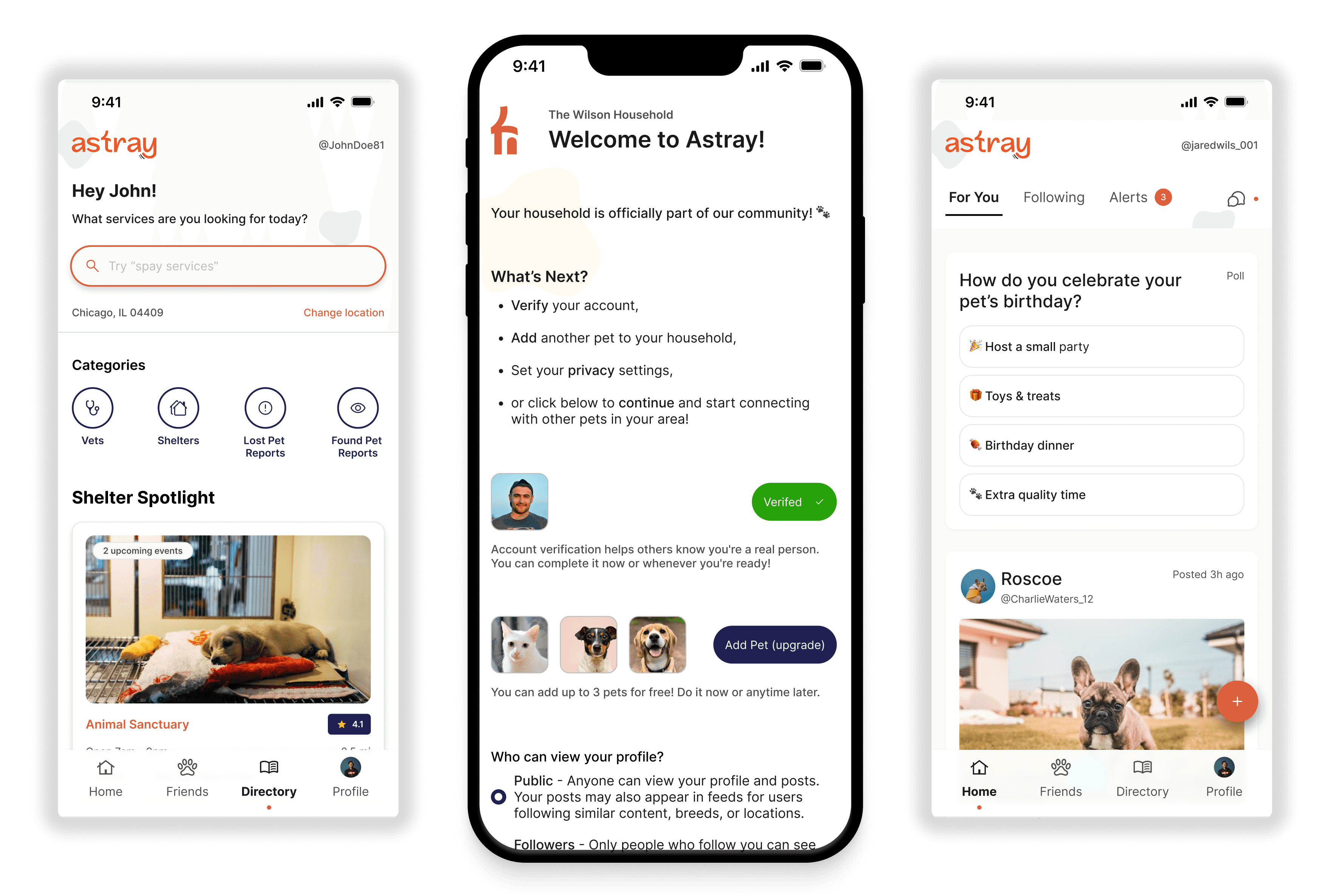
Astray is a community-driven mobile app concept for reuniting lost pets with their owners. The MVP expands pet recovery into an experience people can stay engaged with before an emergency happens.
Sole UX/UI Designer · Product direction, user flows, rapid iteration, high-fidelity UI, design system, clickable Figma prototype, and handoff documentation.
An ambitious vision. A practical first product.
The founder had ambitious ideas, including AI-based paw scanning, but limited resources. My goal was to shape something practical, intuitive, and scalable without losing the mission of helping pets find their way home.
As the only designer, I owned the experience from the initial user flows to the final visual design. I also helped evolve the product from an emergency utility into a community-driven app designed for engagement and retention.
Build community before an emergency.
The audit of Missing Pet App, PawBoost, Missing Pets App, and PetKey exposed a shared product-model gap: passive bulletin boards for an emergency, with no built-in retention loop once it ended. This was an assessment of their experience, not a measured zero-retention rate.
I aligned with the founder on a different model: neighborhood community engagement before an emergency occurs. Local discovery, pet profiles, and friend or follow connections give neighbors reasons to participate between recovery events; sightings and alerts can then reach a community that already exists. That engagement loop is the product hypothesis, not a claimed live retention result.
Recovery tools: competitive references
Missing Pet App, PawBoost, Missing Pets App, and PetKey informed the audit of recovery tools and long-term engagement.
Community discovery: the differentiator
Local discovery gives people a reason to participate before an emergency, extending Astray beyond a one-time recovery utility.
Balance usability, scalability, and MVP feasibility.
I worked closely with the founder to make explicit decisions about what belonged in the first product. Each choice connected a user need with a realistic delivery approach.
Description-based matching and structured photo capture
AI paw scanning introduced reliability and implementation risk; collar QR codes required physical inventory. I scoped the MVP around descriptions and structured photo capture instead: gather identifying details and usable images through a guided lost-or-found report, without hardware or a costly recognition dependency.
Shared household accounts
Multiple people should be able to manage the same pet without creating duplicate lost reports. The Household concept, informed by Ring and Nest, gives pet profiles shared ownership and reduces duplicate alerts.
User-controlled alerts
Rather than depend on a complex urgency-ranking algorithm, users can set their alert radius by zip code and miles. This provides early control over local alerts without prematurely complicating the system.
A hybrid vet and shelter directory
To balance accuracy and sustainability, the first-version direction combines publicly sourced directory information with verified profiles managed by shelters and vets. It also establishes a path toward longer-term partnerships.
Map the core flows before the scope expands.
After clarifying the product direction, I mapped the MVP’s functionality to establish a focused but extensible structure. The core flows cover pet profile creation, lost-pet reporting, local community alerts, a shelter and vet directory, messaging, notification settings, and responses to alerts.
For someone reporting a found pet under stress, account creation cannot be the first barrier. I connected the found-pet entry point directly to reporting, with structured photo capture and identifying details, while recovery journeys connect last-known locations, sightings, and community responses.
Core MVP paths
Document the core features and their connected journeys, including the branches and responses needed for recovery.
Messaging and community profiles
Connect pet and owner profiles with messaging so the community can participate in recovery.
Create the foundation for rapid, consistent iteration.
I built the system around panic-state interactions: high-contrast status treatments distinguish lost, sighted, and safe states; large tap targets make primary actions easier to select; structured photo capture breaks reporting into explicit inputs. Type styles, iconography, reusable buttons, modals, and cards keep those decisions consistent across the MVP.
Time constraints did not allow for a full low-fidelity exploration phase. Instead, I used flow mapping and rapid iteration within the design system to move into high-fidelity mockups, with two focused rounds of feedback and refinement.
Reusable visual language
Define typography, color, iconography, and reusable components for consistent high-fidelity iteration.
Pet profile states
Apply the system to detailed pet information states.
Brand and recovery entry point
Give the product a welcoming identity and a direct found-pet entry point.
Remove entry barriers and define lifecycle behavior.
Two feedback rounds refined recovery entry, neighborhood discovery, and pet lifecycle states. Each change addressed an interaction or product rule rather than a cosmetic preference.
Directory: from a static list to a discovery hub
The initial directory had one list and two tabs for vets and shelters. The refined experience adds smart search, filters for vets, shelters, lost pets and found pets, partner spotlights, and image-rich cards with specialization tags.
Found-pet entry: report before account creation
The original entry launched directly into login. I added an immediate I Found a Pet path so a passerby can report a sighting without creating an account first. Get Started remains available for ongoing community participation, but signup does not block the urgent reporting task.
Friends: intentional connections, one card at a time
A flat list became a focused card layout with larger pet photos and clear owner information. People choose Add Friend, Follow, or Next rather than rely on endless scrolling or quick swipes.
Memorial status: preserve records without sending alerts
Signup supports owners, shelters, vets, and good Samaritans. The pet lifecycle also needs a memorial state: preserve the pet’s profile and records without triggering recovery alert notifications. This separates remembrance from active lost-pet status rather than deleting the record or treating it as an emergency.
Deliver a product the founder can share and build.
I created a clickable Figma prototype covering the core flows, ready for stakeholder conversations, future usability testing, and investor demos. The prototype communicates how the screens work together, not just how they look in isolation.
The walkthrough below shows the prototype in motion: how the core flows connect from entry to recovery, one screen at a time.
The handoff includes an organized Figma file, a clean component library, and final documentation with interaction notes and edge cases. The assets are ready for engineering, with support available once development begins.
Own the experience—not just the screens.
Astray gave me the opportunity to shape a product from scratch while working directly with an early-stage founder. Budget and time constraints demanded both creativity and pragmatism: a clear MVP mattered more than delivering every blue-sky idea.
The result is a complete MVP design, system, documentation, and prototype. This is a design-delivery outcome, not a claim about live adoption or pets recovered.
- Recovery entry: report a found pet before signup, with large tap targets, clear statuses, and structured photo capture.
- Community loop: neighborhood discovery and connections create reasons to participate before an emergency.
- Lifecycle rules: memorial status preserves records without triggering recovery alerts.
- Delivery scope: descriptions and photos replace AI recognition and physical inventory in the first product.
“He didn’t just execute a brief; he invested in understanding the mission and contributed insights that continue to shape the product itself.”
Wendee Lee Curtis · Astray founder, December 2025
a founder’s vision shaped into an MVP